Physics AI Solver with Visuals & Animations
Physics AI Solver
Solve Physics Problems, Learn Concepts, and Get Concise step-by-step Help from your Physics AI Tutor.
Physicstan is a Physics AI solver designed to help students understand how a solution is reached, not just show the final answer. Use it as a physics problem solver for numerical problems, equations, word problems, conceptual questions, diagrams, and homework. Type a question, paste an equation, or upload a photo, image, or PDF. Physicstan identifies the knowns and unknowns, states assumptions, selects the relevant physics principle, rearranges equations, substitutes values with units, checks supported calculations, and adds a useful visual or interactive animation when appropriate.
How the Physics AI Solver Works
Mathematics renders properly rather than as broken plain text, and vectors use vector notation instead of being flattened into scalars when direction matters.
- Interpretation of what the problem is asking
- Known quantities with symbols, values, units, and meanings
- What you are solving for
- Assumptions, written out (frictionless surface, air resistance ignored, g taken as 9.8 m/s²)
- The physical principle and a short note on why it applies here
- Symbol table where it helps
- Equation cards, each with a “use when” line
- Solution steps, one short comment per step explaining why that step exists
- Final answer, highlighted
- Independent checks that actually ran, marked passed or failed
- A real-life intuition and one common mistake
- A practice question with a revealable hint and answer
- Follow-up suggestions you can click to continue
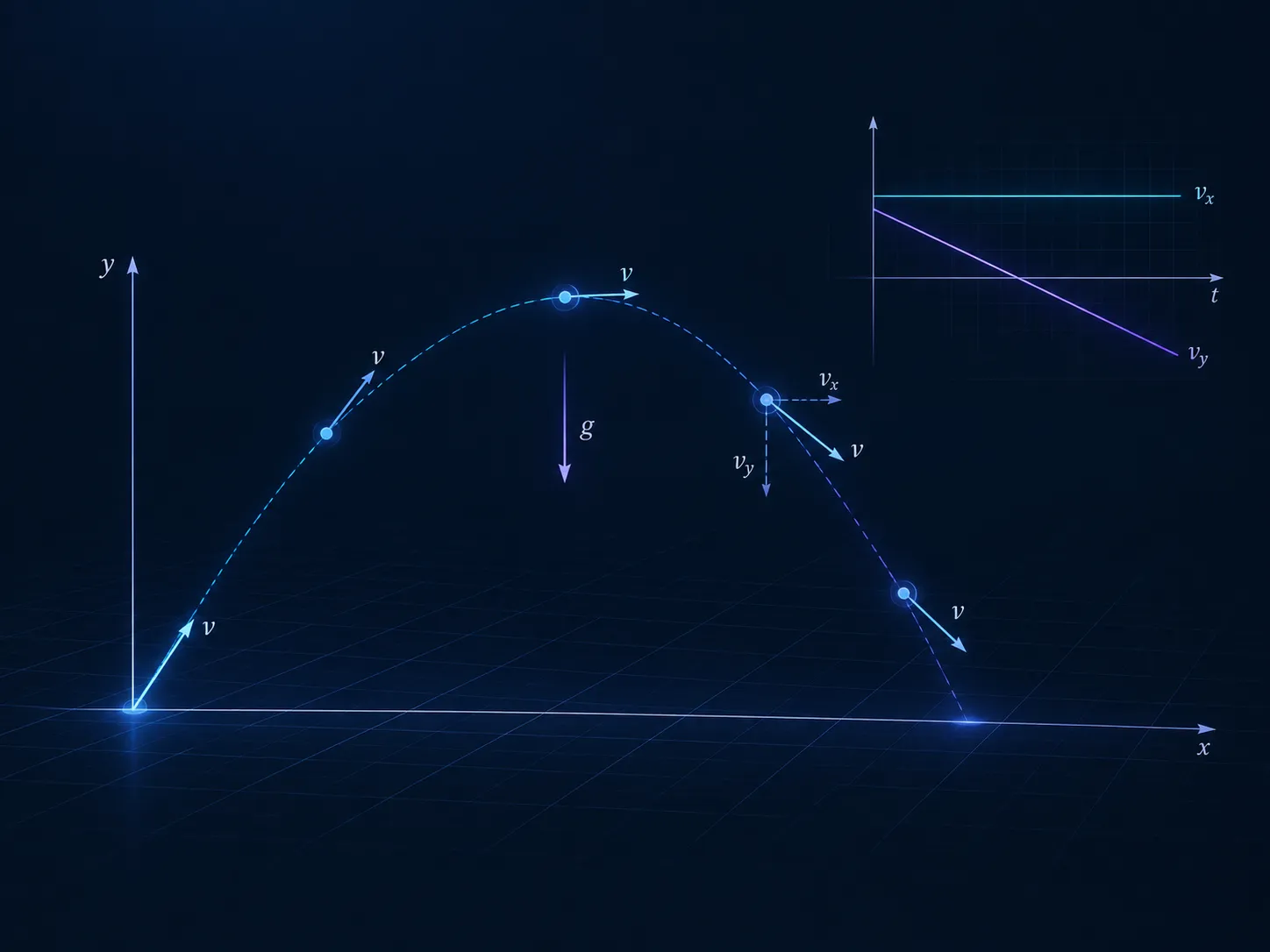
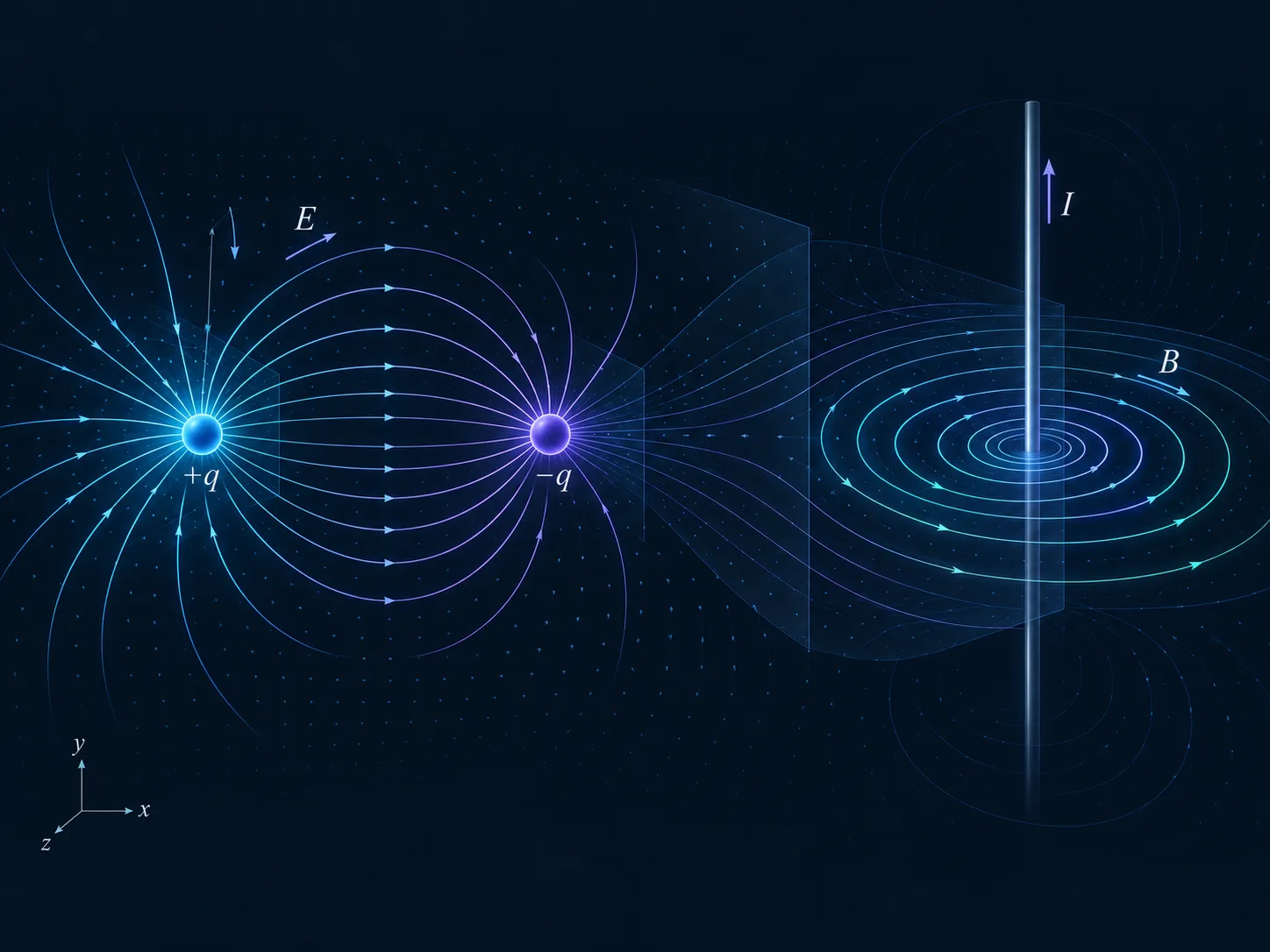
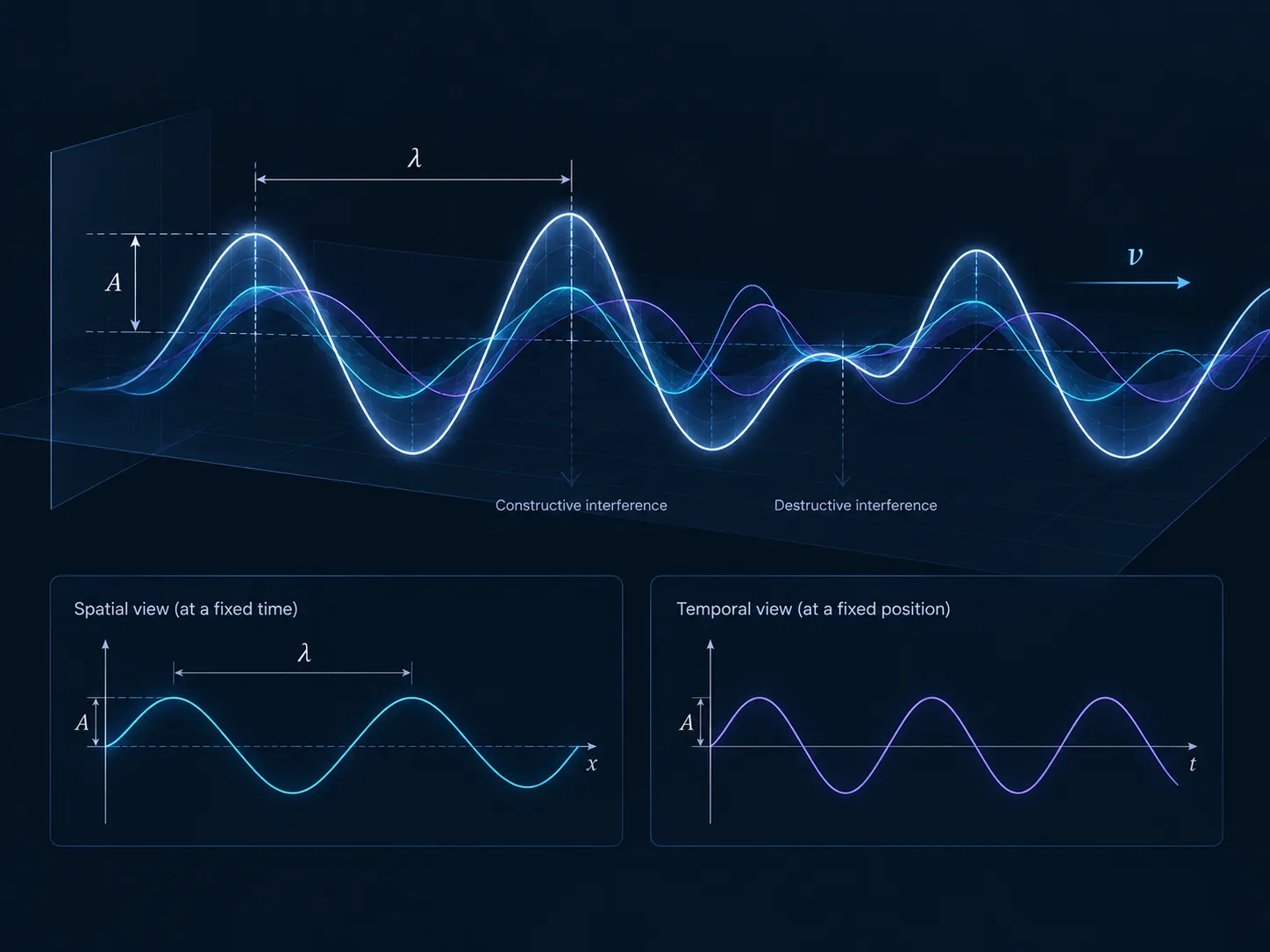
Mathematics renders properly rather than as broken plain text, and vectors use vector notation instead of being flattened into scalars when direction matters, making it the best physics and maths tutor. Supported topics can render deterministic visual cards for constant-acceleration motion, projectile motion, vector components, free-body diagrams, travelling and standing waves, simple harmonic motion, uniform circular motion, mechanical energy, electric fields, magnetic force, DC circuits, thin lenses and pressure–volume diagrams. Animated visual types include Play and Pause controls with live readouts, while concept answers can include a compact concept map.
Use Copy notes to copy the complete answer, or Print / Save PDF to keep a clean study copy for revision.
If the problem is missing information, it says exactly what is missing instead of inventing a number. If your handwriting is ambiguous, it tells you what it thinks the problem says and asks you to confirm before solving the wrong thing.
KNOWN
u = 5 m/s · a = 2 m/s² · t = 4 s
EQUATION
v = u + at
RESULT
v = 13 m/s
Units consistent
Solve Physics Questions in Different Formats
Physics Word Problems
Turn written questions into known quantities, unknowns, assumptions, diagrams when useful, and the governing equations.
Physics Equations
Paste an equation to rearrange it, solve for an unknown, understand its variables, or check your working.
Photos and Handwritten Problems
Upload a photo, screenshot, diagram, or handwritten physics question and work through it step by step.
Numerical and Conceptual Questions
Solve calculations with units and equations, or ask conceptual questions when you need to understand the physics rather than calculate a number.
Physics Problem Solver for Real Student Problems
A useful physics problem solver should help with the parts students actually struggle with: interpreting the question, choosing the right principle, setting up equations, handling units, checking the calculation, and understanding the result.
You understand the concept but freeze on the numerical. This is the single most common complaint physics students post anywhere. You can explain conservation of momentum perfectly well in words and then stare at a problem with two carts and no idea which equation to write first. The gap is not knowledge; it is translation: turning a paragraph of English into a labelled diagram, a set of knowns, and one governing equation. Physicstan always shows that translation step explicitly, before any algebra happens, because that is the part you are missing.
You can only solve a problem after seeing the answer. You look at the worked solution; it makes complete sense, and then the next problem defeats you again. Reading solutions teaches recognition, not method. Tutor mode exists for exactly this: it gives you one hint at the point where you are stuck instead of the finished article, so you produce the next step yourself.
The setup is wrong and everything after it is wasted. Physics punishes a bad setup more than bad arithmetic. Wrong sign convention, wrong reference frame, a normal force assumed equal to weight on an incline, friction pointing the wrong way. Every Physicstan answer states its interpretation of the problem and its assumptions up front, where you can see them and disagree before reading a single line of algebra.
Free body diagrams. Research on physics students keeps finding the same thing: most students do not draw one, and the ones who do score better. You can upload a photo of the diagram you drew and ask what is wrong with it, or ask which forces belong on the body before you commit.
General chatbots quietly get the arithmetic wrong. Ask experienced tutors about using ChatGPT or Gemini for physics and you get a consistent answer: the formulas are usually fine, the final number often is not, because a language model is predicting text rather than calculating. It is easy to miss because the working looks confident. Physicstan re-runs checkable arithmetic through a separate calculator on our server and shows you which checks passed.
It is 1am and the assignment is due at 9. Office hours ended eight hours ago, your study group is asleep, and the textbook’s worked example is not the same problem. This is the situation most physics help gets used in, and it is the reason instant availability matters more than it should.
Homework help sites cost real money and often paywall the exact answer you need. Subscription study sites are a recurring budget complaint among students, and the results are frequently someone else’s uploaded solution rather than an explanation. You get 10 free credits here to test whether the explanations are worth anything before deciding on anything.
You are worried that using AI will hollow out your understanding. A reasonable worry, and there is evidence pointing both ways. One classroom study found students who leaned on a general chatbot performed worse. A Harvard trial using a properly scaffolded AI tutor found roughly double the learning gains compared to an already well-taught active-learning class. The difference is in how the tool behaves, not whether AI is involved. That is why Tutor and Learn modes exist alongside Solve, and why the answer format is built around method rather than final numbers.
Solve, Learn, Tutor and Check Physics Problems
Solve returns the complete worked solution. Use it to check a finished answer, to see a method end to end, or when you are out of time.
Learn teaches the concept instead of grinding a number. You get a short summary, a symbol and quantity table, two to five equation cards each with a note on when to use it, one real-life example, one common mistake, and a short practice question with a hint and answer you can reveal when you want them. It is deliberately not an essay.
Tutor works like an AI physics tutor: it leads with one useful hint or guiding question instead of immediately giving away the answer. You can use it as an online physics tutor when you need help understanding the next step, and you can request the full solution at any time. Learn more on the Physics AI Tutor page.
Check My Work takes your attempt and finds the earliest point where it actually breaks. It preserves valid alternative methods rather than replacing your approach with its own, and it tells you whether later errors are just consequences of the first one.
Physics Solver Accuracy and Independent Checks
Most physics AI sites advertise a headline accuracy figure. You will see 98.5% and 99.7% on competing pages, with no test set, no methodology, and no independent testing behind either number. Those are marketing claims.
Here is the actual state of the research. Researchers at Stanford and Auburn tested GPT-4 on forty problems from a college engineering physics course. On well-specified problems, where every needed value was given, it solved 62.5% correctly. On under-specified problems, where something had to be estimated, that fell to 8.3%. The three failure patterns they identified were building an inaccurate model of the physical situation, making unreasonable assumptions about missing data, and plain calculation errors (Wang et al., Frontiers in Education, 2024).
Physicstan is designed around those three failures rather than around denying them.
Assumptions get surfaced. They appear in their own block. A hidden assumption is the usual route to a confident wrong answer.
Missing data is flagged, not invented. The model is instructed never to fabricate a numerical value, constant or citation. If a problem cannot be solved as written, it says which quantity it needs.
Arithmetic is re-checked outside the model. Where a calculation can be independently verified, our server re-evaluates it with a deterministic parser that has nothing to do with the language model. Unit dimensions get the same treatment. The AI is explicitly forbidden from declaring its own answer verified. Only checks that ran and passed are displayed as passed, and failed checks are shown as failed.
We do not confuse a dimensional check with proof. A dimensionally consistent answer can still be physically wrong. The checks catch calculation slips, not conceptual errors.
Read the reasoning, not just the number at the bottom. Full detail on the method and its limits is on the accuracy and method page.
What Physics Problems Can Physicstan Solve?
Physicstan is designed as an AI physics tutor and problem solver for high-school physics through introductory college and university physics. It can help with numerical, conceptual, equation-based, and visual problems across the major introductory physics topics.
Mechanics and kinematics, Newton’s laws, work and energy, momentum and collisions, circular and rotational motion, gravitation, fluids, thermodynamics, waves and sound, simple harmonic motion, geometric optics, electrostatics, DC circuits, magnetism and induction, and introductory modern physics. High school through introductory university level is where it is strongest.
Typical uses:
- Going through a problem set one question at a time with hints before solutions
- Photographing a circuit or free-body diagram and asking what is happening in it
- Checking a finished answer before you submit
- Getting a concept re-explained after a lecture that moved too fast
- Understanding why a marked answer was wrong
- Preparing for AP exams alongside the free AP Physics score calculator
For a whole assignment, start at physics homework help, which is set up for uploading and working through multiple questions. For problems to attempt rather than problems to solve, use physics practice problems.
Credits, privacy and account
Create an account, verify your email, and you receive 10 free credits.
- One substantive request costs one credit.
- A request that fails on our side costs nothing.
- Reading an old answer, reopening a conversation, revealing a hint or copying a solution is always free.
- Credits are tracked in a server-side ledger, so a double-submitted request does not silently charge you twice.
Conversations are private records tied to your account and are not published or indexed anywhere. Uploaded files are stored outside the WordPress media library rather than in a public uploads folder. You can delete any conversation yourself at any time, and uploaded files are removed automatically after a retention period.
Plans and monthly credit allowances are on the pricing page.
Physics AI Solver FAQs
Accuracy and trust
How accurate is it?
It is reliable on standard high school and introductory university problems and less reliable as problems get more specialised, more open-ended, or require estimating missing data. We do not publish a single accuracy percentage because a number without a stated test set is meaningless. What is checked automatically is described on the accuracy page.
What are the “independent checks” on an answer?
Where the AI produces arithmetic that can be verified, our server recalculates it separately and compares. It does the same for the dimensional class of common units. Those checks are run by our backend, not by the AI, and only genuinely passing checks are shown as passed.
What do I do if an answer looks wrong?
Say so in the conversation and ask it to re-derive or use a different method. There is also a thumbs down and a Report button on every answer, and reports come to us. If something looks wrong to you, that instinct is usually worth following.
Will it make up a number if the problem is incomplete?
It is instructed not to. It should tell you which value is missing and ask for it. If you ever see it invent one, please report that answer.
Is it better than asking ChatGPT?
For physics specifically, the differences are the fixed answer structure, the assumptions block, the independent arithmetic checks, and the fact that you are not re-prompting the model into behaving like a tutor at the start of every session. A general chatbot can do a lot of this if you prompt it well. This does it by default.
How is this different from Chegg or Course Hero?
Those are largely libraries of previously submitted solutions. This generates a solution for your specific problem and will discuss it with you. There is no waiting for a human expert and no searching for whether your exact question already exists.
How is it different from Photomath or Wolfram Alpha?
Those are strongest on symbolic mathematics. Physics problems usually fail at the modelling stage rather than the algebra stage, which is what this is built around.
Can Physicstan solve a physics problem from a photo or picture?
Yes. You can upload a photo, screenshot, diagram, handwritten problem, or supported PDF. If an important value or handwriting is unclear, Physicstan asks you to confirm it rather than silently guessing.
Can Physicstan solve physics equations and word problems?
Yes. It can identify known and unknown quantities, choose the relevant physics principle, rearrange equations, substitute values with units, and explain the solution step by step.
Can I try the Physics AI solver for free?
Yes. New users receive 10 free credits so you can test solving, tutoring, checks, visuals, and supported animations before choosing a paid plan.
Using it
Do I need an account?
Yes, for free credits, because credits and conversation history are tied to an account. Registration asks for your full name, email, country, academic role and a password.
Why do I have to verify my email?
Free credits are granted after verification. It is the simplest way to stop one person creating unlimited free accounts, and it means your conversation history survives.
Can it read my handwriting?
Usually, if the photo is in focus and reasonably lit. Diagrams, circuit sketches and graphs generally work. Blurry or very dark photos give worse results. If the writing is ambiguous, it will tell you what it read and ask you to confirm rather than guessing.
What files can I upload?
JPG, PNG, WebP and PDF, up to the size limit shown in the uploader.
Can I upload a whole problem set?
You can upload a multi-page PDF, but you will get better results working through it question by question. The homework help page is set up for that workflow.
Can I ask follow-up questions?
Yes, and follow-ups are the point. The conversation keeps context, so you can ask why a step was taken, request another method, or push back on an assumption without restating the problem. Each substantive follow-up costs one credit.
Can I switch modes in the middle of a conversation?
Yes. Solve something, then switch to Learn to have the confusing part explained, without losing anything.
Does it work on a phone?
Yes. Photographing a problem from your phone is the most common way people use it.
Does it work in languages other than English?
It works best in English with standard SI notation. Questions in other languages often work when the equations and numbers are clear, but English gives the most reliable results.
Credits and billing
How many free credits do I get?
10 after email verification.
What uses a credit?
One substantive request to the AI. That includes a solve, a tutor follow-up, a check my work submission, or asking for a different method. Reading, reopening, revealing hints and copying cost nothing.
Do I lose a credit if the answer fails to generate?
No. Failed requests are not charged.
Do unused credits roll over?
Unused credits currently accumulate rather than expiring at the end of a billing period.
What does a subscription cost?
Current plans, prices and monthly credit allowances are listed on the pricing page.
Can I cancel?
Yes, through the billing portal from your account page. Cancellation and refund terms are on the refund policy page.
Is there a rate limit?
There is a per-minute and per-hour request limit to keep the service stable and to prevent automated abuse. Normal studying will not come close to it.
Privacy and academic integrity
Are my conversations private?
Yes. They are records tied to your account. Other users cannot see them, and they are never published as public pages or indexed by search engines.
What happens to photos I upload?
They are stored outside the public media library and removed automatically after a retention period. You can delete a conversation at any time from your account.
Do you sell my data?
No.
Is using AI for physics homework cheating?
That depends entirely on your institution, and their policy is the one that counts. Checking your own work, having a concept explained, or being guided toward an answer you then produce yourself is normally acceptable. Submitting a generated solution as your own usually is not. If in doubt, ask your instructor before rather than after.
Can I use it during an exam or quiz?
No, unless your instructor has explicitly said outside tools are allowed. Assume they are not.
Will my teacher be able to tell?
Beside the point. The useful question is whether you could reproduce the solution under exam conditions. If not, you have not finished studying, whatever the assignment says.
Level and coverage
Does it handle AP Physics?
Yes, across AP Physics 1, 2, C: Mechanics and C: Electricity & Magnetism topics. Physicstan is not affiliated with or endorsed by the College Board.
Does it handle IB and A-Level?
The topic coverage lines up with both. We are not an official provider for any exam board.
Is it calculus-based or algebra-based?
Both. It adapts to how the question is posed, and you can ask for a calculus-based treatment explicitly.
Will it help with university physics?
For first and second year material, generally yes. For upper-division, highly specialised or research-level work, treat it as a study aid and verify against your course materials.
Can it help with lab reports or error analysis?
It can discuss uncertainty, propagation and significant figures. It cannot analyse your raw data file or write your report for you.
Does it explain concepts, or only solve problems?
Both. Ask it to explain something and it will produce a concept lesson rather than hunting for a number to calculate, even from Solve mode.
Solve Physics Problems with Visuals & Interactive Animations
Physicstan goes beyond a text-only physics solver by adding relevant visuals and interactive animations when they help explain the physics. Work through mechanics, fields, circuits, waves, and oscillations while connecting the equations to what the physical system is actually doing.