
AP Physics 1 Practice Problems & Questions
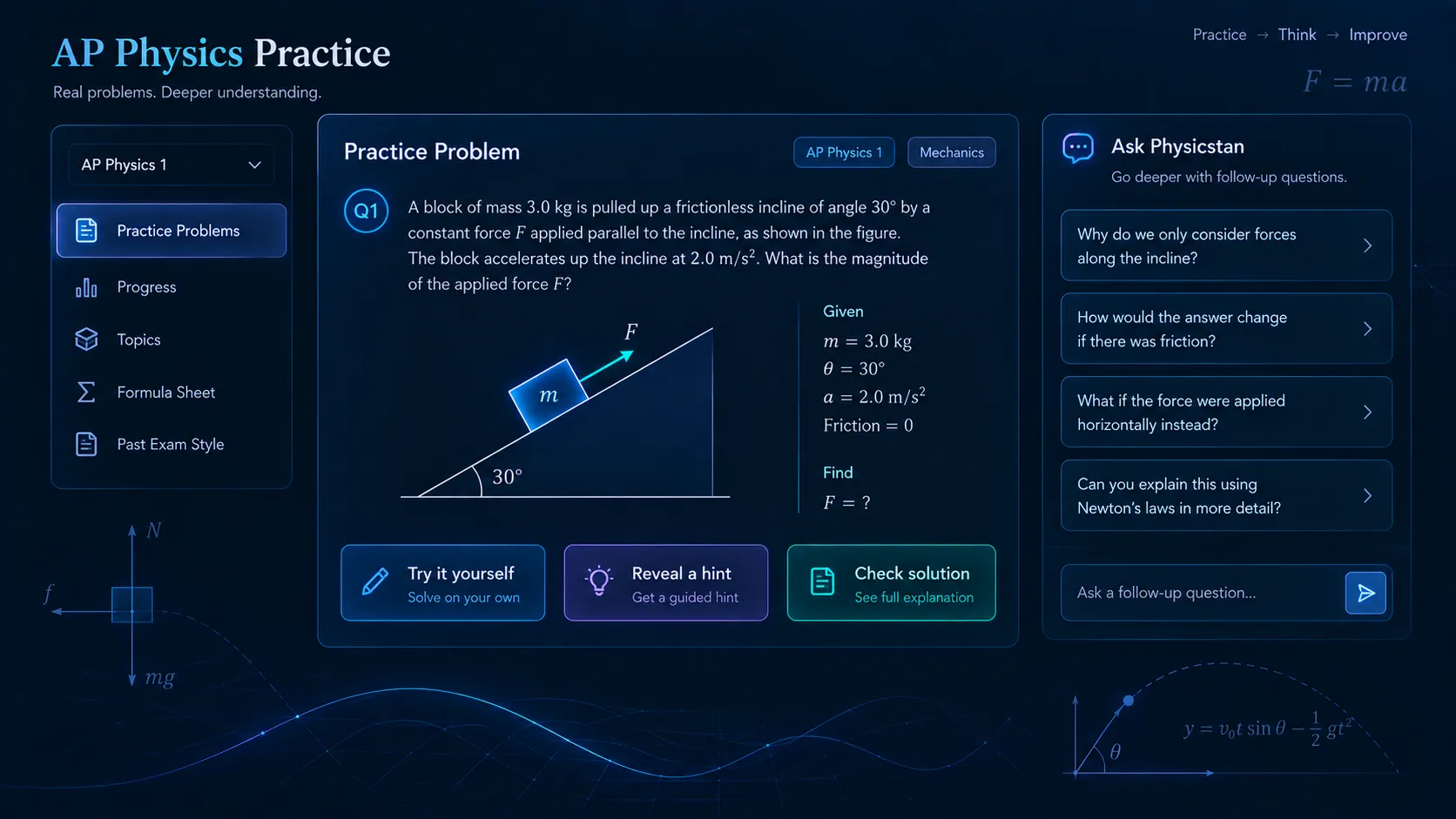
Attempt each problem on paper first, take the hint only if you are stuck, then reveal the worked solution and compare methods rather than just answers.
These are original problems written for AP Physics 1, spanning the seven units of the current course including fluids. They are practice problems, not a mock exam, and they are free with no account needed.
What the current exam actually asks of you
Worth knowing before you practise, because it changes how you should practise.
From the May 2027 exam, AP Physics 1 is 42 multiple-choice questions in 85 minutes and 4 free-response questions in 95 minutes, with each section worth exactly 50%. The four free-response questions are one each of mathematical routines, translation between representations, experimental design and analysis, and qualitative/quantitative translation.
Two consequences follow.
Four questions carry as much weight as forty-two. Students who neglect free response because “it is only four questions” are making an arithmetic error. Half your score sits there.
Justification is a scored skill, not decoration. Rubric points go to stating the relationship you are using, referencing a physics principle, and explaining the reasoning behind a result. Producing the right number without the reasoning is the standard way strong students under-score. Practise writing the justification, not just the calculation.
Confirm the format for your exam year on the official AP Physics 1 exam page.
Also note that fluids is now part of AP Physics 1, having moved over from Physics 2. If your review book does not cover buoyancy and pressure under Physics 1, it predates the revision.
Kinematics and dynamics
Problem 1. A 3.0 kg block on a frictionless horizontal table is connected by a light string over a frictionless pulley to a 2.0 kg block hanging freely. Find the acceleration of the system and the tension in the string.
Hint
Treat the two blocks as one system to get the acceleration, since they must move together. Then apply Newton’s second law to one block alone to get the tension. Ask yourself which forces are external to the system and which are internal.
Solution
For the system, the only external driving force is the weight of the hanging block:
a = m₂g / (m₁ + m₂) = (2.0 × 9.8) / 5.0 = 19.6 / 5.0
a = 3.9 m/s²
Now for the 3.0 kg block alone, tension is the only horizontal force:
T = m₁a = 3.0 × 3.92
T ≈ 12 N
Check: the tension is less than the hanging block’s weight of 19.6 N. It must be, or the hanging block would not accelerate downward.
Energy
Problem 2. A spring of stiffness 200 N/m is compressed by 0.15 m and used to launch a 0.40 kg block along a frictionless horizontal surface. Find the block’s speed as it leaves the spring.
Hint
All the elastic potential energy stored in the spring becomes kinetic energy. Write both expressions and set them equal before substituting anything.
Solution
Elastic potential energy stored:
E = ½kx² = ½ × 200 × (0.15)² = ½ × 200 × 0.0225 = 2.25 J
Setting this equal to kinetic energy:
½mv² = 2.25
v² = (2 × 2.25) / 0.40 = 11.25
v ≈ 3.4 m/s
A common error is using x rather than x² in the spring energy expression. The units are the fastest way to catch it.
Momentum and impulse
Problem 3. A 0.15 kg ball strikes a wall horizontally at 20 m/s and rebounds at 15 m/s in the opposite direction. The contact lasts 0.020 s. Find the average force exerted by the wall on the ball.
Hint
Momentum is a vector. The ball reverses direction, so the two velocities have opposite signs. This is where most of the marks are lost on this question type.
Solution
Take the initial direction as positive. Then the final velocity is −15 m/s.
Δp = m(v − u) = 0.15 × (−15 − 20) = 0.15 × (−35) = −5.25 kg m/s
F = Δp / Δt = −5.25 / 0.020
F ≈ −260 N, meaning about 260 N directed away from the wall
If you got 38 N, you subtracted the speeds instead of treating them as opposite vectors. That single sign is the difference between most of the marks and almost none.
Circular motion and gravitation
Problem 4. A car travels over the inside of a vertical circular loop of radius 2.5 m. What is the minimum speed at the top of the loop for the car to maintain contact with the track?
Hint
At the minimum speed, the normal force from the track becomes zero. What is left to provide the centripetal force?
Solution
At minimum speed, N = 0, so gravity alone supplies the centripetal force:
mg = mv²/r
v = √(gr) = √(9.8 × 2.5) = √24.5
v ≈ 5.0 m/s
The mass cancels, so this minimum speed is the same for any vehicle. A frequent misconception is that something must push the car up at the top. Nothing does. Gravity is the centripetal force, pointing toward the centre, which at the top means downward.
Rotational motion
Problem 5. A uniform rod of mass 2.0 kg and length 1.2 m is pivoted at one end and held horizontally, then released. Find its angular acceleration at the instant of release. For a rod about one end, I = mL²/3.
Hint
The weight acts at the centre of mass. Where is that, and what is its perpendicular distance from the pivot?
Solution
Torque about the pivot, with weight acting at the centre at L/2:
τ = mg(L/2)
Applying the rotational form of Newton’s second law:
α = τ/I = [mg(L/2)] / (mL²/3) = 3g / (2L)
α = (3 × 9.8) / (2 × 1.2) = 29.4 / 2.4
α ≈ 12 rad/s²
The mass cancels again. Note the tip of the rod has a linear acceleration of αL = 14.7 m/s², which exceeds g. This is why a coin placed near the far end of a hinged falling rod appears to be left behind.
Fluids
Problem 6. A block of density 600 kg/m³ floats in water of density 1000 kg/m³. What fraction of its volume is submerged?
Hint
Floating means the buoyant force equals the weight. Write both in terms of density and volume, and see what cancels.
Solution
For floating equilibrium, the weight of displaced water equals the weight of the block:
ρ_water × V_submerged × g = ρ_block × V_total × g
V_submerged / V_total = ρ_block / ρ_water = 600 / 1000
0.60, meaning 60% submerged
The result is just the ratio of densities, which is worth committing to memory. It also explains why roughly 90% of an iceberg sits below the waterline, ice being about 917 kg/m³ against seawater at about 1025 kg/m³.
Simple harmonic motion
Problem 7. A 0.25 kg mass on a spring oscillates with a period of 0.80 s. Find the spring constant.
Hint
Rearrange the period expression for a mass-spring oscillator to make k the subject before substituting. Squaring is involved, so do it symbolically first.
Solution
T = 2π√(m/k)
Squaring and rearranging:
k = 4π²m / T² = (4π² × 0.25) / 0.64 = 9.8696 / 0.64
k ≈ 15 N/m
Note the period does not depend on amplitude, which is the defining feature of simple harmonic motion and a frequent multiple-choice trap.
How to get more out of these
Write the justification. For each problem above, after getting the number, write one sentence explaining why the principle you used applies. That sentence is what the free-response rubric is paying for, and it is the part nobody practises.
Do the qualitative version. Take Problem 4 and ask what happens if the radius doubles. Take Problem 6 and ask what changes in salt water. Reasoning about relationships without numbers is exactly what the qualitative/quantitative translation question tests.
Practise the experimental question separately. One of the four free-response questions is experimental design and analysis, usually requiring you to linearise a relationship and say what a graph’s slope represents. It is a distinct skill from problem solving and it is the least practised of the four.
Redo from blank paper a day later. If you cannot reproduce it, you have not learned it, whatever the first attempt suggested.
Got a different answer?
Paste your working into Check My Work on the Physics AI solver and it will find the earliest step that actually breaks, preserving your method rather than substituting its own. For a hint at a time rather than a full solution, use Tutor mode.
Where to go next
- Scoring a practice exam: AP Physics 1 score calculator
- Other courses: AP Physics score calculator hub
- Broader problems beyond the AP syllabus: physics practice problems
- A whole assignment rather than loose questions: physics homework help
Common questions
Are these real AP exam questions? No. They are original problems written to match the style and difficulty of the course. College Board does not release its multiple-choice questions, since they are reused. Official released free-response questions are available free on AP Central and are the best supplementary practice there is.
Is this a full practice test? No. These are practice problems for building method. For timed full-length practice under exam conditions, use AP Classroom through your teacher and the Bluebook test previews.
Does AP Physics 1 really include fluids now? Yes, it moved over from Physics 2 in the course revision. Older prep material will not cover it under Physics 1.
How hard is AP Physics 1? Less brutal than its reputation since the revision. In 2026, 68% of students scored 3 or higher. Before the revision that figure sat in the mid-forties.
Do these problems cost credits? No. This page is free and needs no account. Credits are only used when you ask the AI a question.
Is Physicstan affiliated with the College Board? No. AP and Advanced Placement are registered trademarks of the College Board, which does not endorse and was not involved in producing this material.