Best AI for Physics: An Honest Comparison
Disclosure before anything else: I build one of the tools in this comparison. Physicstan is mine. I am Muzammal Amin, a PhD researcher in Physics at the University of Turin, and I have an obvious commercial interest in what you conclude.
So read the section on where competitors beat Physicstan more carefully than anything positive I write about it. That section is real, it is specific, and it opens with the fact that Physicstan is the most expensive option per question of everything reviewed here.
What I did and did not do
Being precise about this matters, because the phrase “we tested” does a lot of unearned work across this category.
What I did, in September 2026:
- Opened and read the live pages of every tool listed, recording free tiers, prices, feature claims, disclosed operators and stated limitations
- Cross-checked every accuracy claim against the peer-reviewed literature on AI performance in physics
- Checked each site’s claims for internal consistency, including against its own disclaimers and against other pages on the same site
- Compared cost per question on a like-for-like basis
What I did not do: run a blind head-to-head benchmark of solution quality. Doing that properly means thirty or more original unpublished problems, blind marking against a fixed rubric, and an independent marker, because I am not a neutral party. Until that exists I am not going to tell you my tool solves physics better than someone else’s, and you should distrust anyone who tells you theirs does without showing their working.
What follows is a claims-and-capability audit rather than a solution-quality benchmark. It turned out to be more revealing than a benchmark would have been.
The claims problem
Start here, because it changes how you read every product page in this category.
Math AI (math-gpt.ai) states in its FAQ that its physics solver has 99.9% accuracy. On the same page, directly beneath its chat window, it displays: “Math AI can make mistakes. Check important info.” Both statements sit on the same URL. The same FAQ says the tool was “trained on millions of physics problems,” which describes building a foundation model, not what a web wrapper around a commercial API does.
Energent.ai advertises 98.5% solution accuracy across its physics pages. Two of those pages carry testimonials from the same set of named people. On one, Richard Song is a “Physics Professor,” Jon Conradt is a “Lead STEM Tutor,” and Jamal is “Head of Science Dept.” On the other, Richard Song is a “University Student,” Jon Conradt is a “Physics Tutor,” and Jamal is a “High School Student.” The headline statistics differ too: one page claims 10k+ problems solved daily, the other 1M+ problems solved; one says 15 minutes saved per problem, the other 5 hours saved weekly.
A Chrome Web Store listing for another physics AI claims 99.7% accuracy. No test set there either.
None of these publishes a problem set, a scoring rubric, a sample size or an independent verifier.
Now set those numbers against the research. Stanford and Auburn researchers tested GPT-4 on forty problems from a college engineering physics course. It solved 62.5% of well-specified problems, where every needed value was supplied, and 8.3% of under-specified problems where a quantity had to be estimated. Failures fell into three categories: building an inaccurate model of the physical situation, making unreasonable assumptions about missing data, and plain calculation errors (Wang, Burkholder, Wieman, Salehi & Haber, Frontiers in Education, 2024).
These products are wrappers around frontier models. Good prompting and verification can improve on the base model. Nothing takes 62.5% to 99.9%.
Treat an accuracy percentage with no methodology as evidence against a tool rather than for it. It tells you the operator will publish a number they cannot support, which is worth knowing before you trust their physics.
What the research actually supports
Three findings worth carrying into any decision.
Performance depends enormously on how the problem is posed. The eightfold gap between well-specified and under-specified problems is the most useful fact here. If your homework supplies every number, AI is a reasonable assistant. If it asks you to estimate a coefficient of friction or the mass of a vehicle, expect it to fail while sounding exactly as confident.
Scaffolding matters more than the model. A Harvard study of 194 students in an introductory physics course compared a purpose-built AI tutor against the department’s existing, heavily refined active-learning class. Learning gains from the AI sessions came out roughly double, with higher reported engagement. The tutor was not a raw chatbot: the researchers wrote structured teaching instructions, scaffolded its behaviour and pre-vetted its feedback (Harvard Gazette).
Unstructured use can make things worse. Separate classroom research has found students relying on a general chatbot performing worse than controls, with concerns raised about reduced critical engagement.
The same underlying model helps or harms depending on what is built around it. That is the thing to evaluate in a product.
What to judge a physics AI on
Feature lists date. Any of these products can add a mode or a diagram generator in a sprint, and several will. If you choose on a checklist you will be choosing on something that is out of date by the time you renew.
Four things are slower to change and tell you more.
Who is responsible for the physics. Every tool here runs on the same handful of frontier models. What differs is who wrote the instructions wrapping them, who decided what a correct answer looks like, and whether that person understands physics or understands conversion rates. A site that will not tell you who built it has told you something.
Whether the tool will admit what it cannot do. This is a disposition, not a feature, and it is the hardest thing to fake because it costs conversions. A product that publishes its failure modes is a product whose operator expects you to check, which is the correct relationship to have with an AI answering physics questions.
Whether the design reflects how physics is actually learned. Students do not fail at algebra. They fail at translating a paragraph into a labelled diagram and one governing equation. A tool built by someone who has watched that happen separates setup from algebra. A tool built to demo well returns a fast, tidy answer that skips the part you were stuck on.
Whether correctness is architectural or advertised. A percentage on a landing page costs nothing to type. Verification that runs on every answer and can report its own failure costs engineering and occasionally makes the product look worse. Only one of those is evidence.
The rest of this article applies those four tests.
Who built these tools
Worth doing before the feature comparison, because it is the part that does not change next quarter.
PhysicsAI.io names an operating company, Swift Digital Tools LLP in London, and an address. No individual is named, and nothing on the site indicates a physicist was involved in designing the physics behaviour. It discloses openly that it runs on third-party models, which is more than most.
Math AI (math-gpt.ai) names no operator. Its footer links to partner sites for AI video generation and image editing, which suggests a portfolio of AI wrappers rather than a subject specialism. Its testimonials are attributed to people with letter avatars rather than verifiable identities.
Energent.ai names no individuals. The same testimonial names appear with contradictory job titles across its own pages, as set out above.
physicsai.chat names no individuals, but its FAQ is written with genuine subject awareness. Someone who understands physics teaching wrote the section about confirming advanced results with an instructor.
Physicstan is built and maintained by me, Muzammal Amin, a PhD researcher in Physics at the University of Turin, working in the Department of Physics on personal exposure assessment for radiofrequency electromagnetic fields, in collaboration with ARPA Piemonte, the regional environmental protection agency. You can verify that on the University of Turin PhD programme page rather than taking my word for it.
The relevant credential is not the research specialism. Exposure modelling has nothing to do with teaching mechanics. What is relevant is that I have taught physics and mentored students, and the design of this tool comes from having watched where people actually get stuck rather than from guessing at it. The physics methodology and answer contract were written by a physicist, not adapted from a general homework template.
One thing I will not claim: the bundled benchmark dataset is still marked pending review, so Physicstan is not currently an expert-verified product and I am not going to describe it as one. When that review is done, this page will say so.
The tools
General frontier models: Claude, ChatGPT, Gemini
Best for: conceptual explanation, unusual problems, and arguing with an answer until it makes sense.
These are the strongest general physics reasoners available, and nearly every physics-specific product below is a wrapper around one of them. Physicstan runs on Claude Sonnet and OpenAI models and says so openly.
Their known weakness is arithmetic. Language models predict text rather than calculating. The pattern experienced tutors report constantly is a correct formula followed by a wrong number, easy to miss because the working looks assured. Telling the model to run the calculation in code fixes most of it, and almost no student does.
They also behave however you prompt them. Ask for help and you get a finished solution, the least useful outcome if you are trying to learn. Reproducing the Harvard result in a default chat window means building the scaffolding yourself, every session.
Free tiers are usable. Paid tiers run around $20 a month and give you far more than physics.
Wolfram Alpha
Best for: verifying algebra, integrals, symbolic manipulation and unit conversion.
Effectively never wrong about the mathematics. Worth keeping open alongside whatever else you use.
What it will not do is read a word problem and work out which physics applies. Since translating prose into a labelled diagram and one governing equation is exactly where most students fail, Wolfram solves the part you were not stuck on. An exceptional calculator, not a tutor.
PhysicsAI.io
Operated by Swift Digital Tools LLP, London.
Free: 10 tutoring requests. Monthly: $6 for 400 requests. Yearly: $4.50 a month, 4,800 requests annually, with a 3-day trial on paid plans. Covers physics, mathematics, chemistry and other STEM subjects, so it is broader than physics alone.
What it does well. No accuracy percentage plastered across the homepage, which by this category’s standards is real restraint. A clear academic integrity statement telling users not to submit AI output as their own work where rules prohibit it. Open disclosure that it runs on third-party AI models and is not affiliated with the providers. A named operating company and address in the footer. Those four things together put it ahead of most of the category on straightforwardness.
At roughly $0.015 a request monthly, and under $0.01 annually, it is substantially cheaper than Physicstan.
Physics AI (physicsai.chat)
Free: 7 permanent credits. Standard: $5.90 a month for 500 credits. Pro: $11.90 a month for 1,500 credits, with yearly discounts.
What it does well. Two modes, Solver and Tutor, the tutor described as Socratic. Its notable feature is visual generation: ask it to draw something and it produces free body diagrams with vector arrows, kinematic graphs, and circuit and pulley layouts. It covers a wider range of diagram types than Physicstan does, so if you want a picture of a multi-pulley system or a lens bench, this is the one that will draw it.
Those visuals are generated images. You look at them. You cannot change the numbers and watch what happens, which is a different capability covered below.
Its FAQ is unusually honest too. It states plainly that very advanced or research-level problems should be confirmed with your instructor, that blurry photos produce worse results, and that you should not use it during tests unless permitted. That is a company describing its own limits instead of hiding them.
Math AI (math-gpt.ai)
Free: usable with no signup at all, which is a real convenience advantage over everything else here.
Supports JPG, PNG, WebP and PDF, with a LaTeX equation editor built into the input. Also covers chemistry and biology.
The 99.9% claim sitting on the same page as its own “can make mistakes” disclaimer is covered above. Testimonials are attributed to generic names with letter avatars rather than verifiable people.
Photo solver apps
Best for: speed on a phone, and problems you cannot type.
The app stores are crowded with near-identical listings making near-identical claims. Several put step-by-step solutions behind a subscription after a small free allowance, sometimes without making that clear before install. Quality varies enormously and review counts are thin on most. Convenient, hard to evaluate.
Physicstan
Stated as verifiable design facts, since I have not benchmarked solution quality. Several of these are things I could not find in any other tool reviewed here.
Arithmetic is verified outside the AI. This is the one that matters most, because it targets the failure mode every tool in this category inherits and none of the others addresses. When the model produces a calculation that can be checked, our server re-evaluates it with a deterministic parser: a tokeniser, a shunting-yard conversion and a stack evaluator. No language model touches it. Unit dimensions get the same treatment against a fixed library. The model is explicitly forbidden from declaring its own answer verified, and a failed check displays as failed rather than being hidden. Competitors publish accuracy percentages. Physicstan shows you, per answer, which specific checks actually ran and which passed.
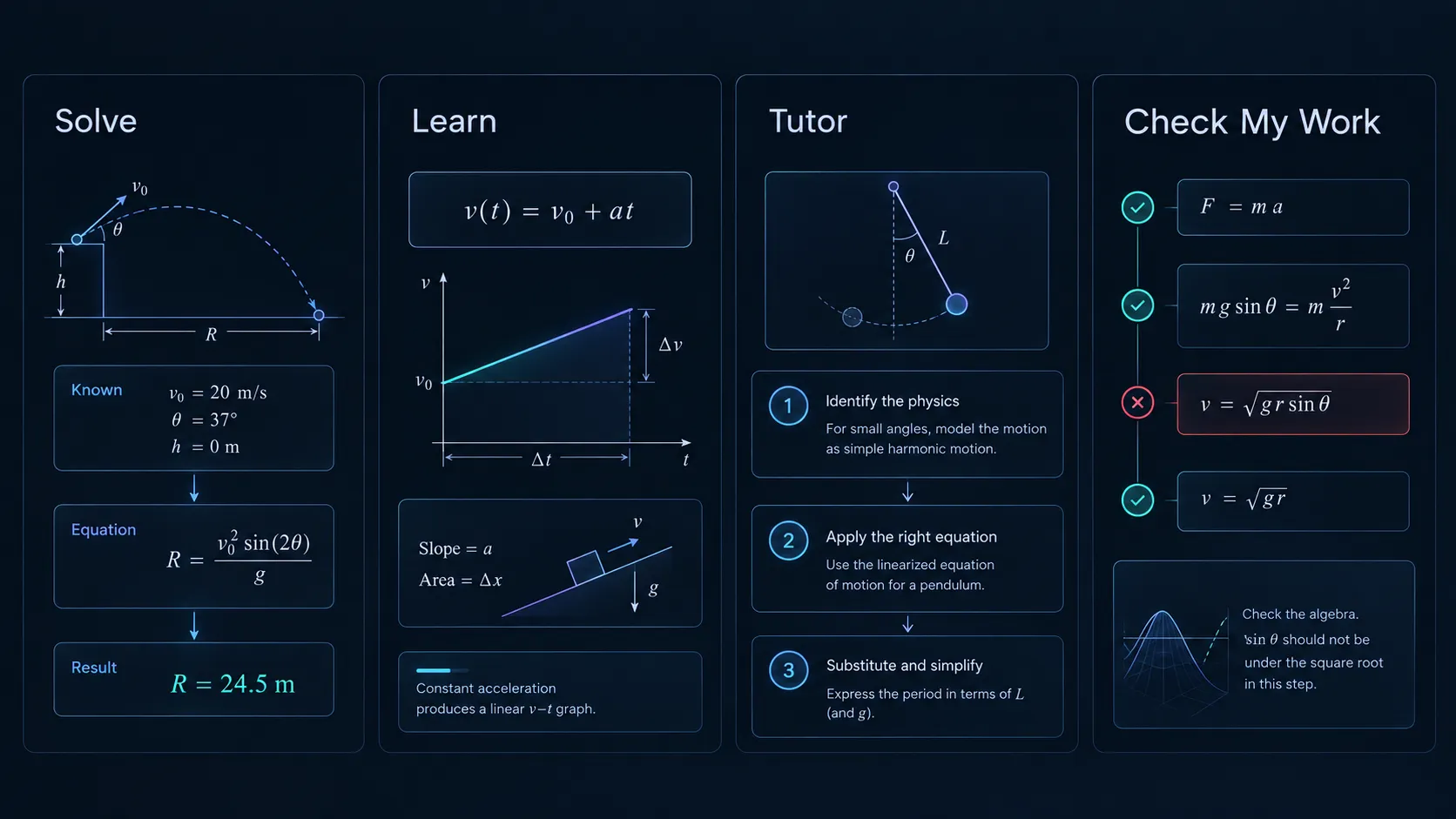
Answers are structured rather than prose. Interpretation, knowns, unknowns, assumptions, governing principle, symbol table, equation cards each with a “use when” note, worked steps with a one-line reason each, highlighted final answer, verification badges, real-life intuition, common mistakes, a practice question with revealable hint and answer, and clickable follow-up suggestions. Not a wall of text you have to mine.
Complete answers can become study notes. Copy notes copies the full rendered answer in one action. Print / Save PDF opens a clean print view so the same answer can be printed or saved as a PDF for revision.
Assumptions get their own block. A hidden assumption is the usual route to a confident wrong answer, so they are surfaced where you can disagree with them before reading a line of algebra.
It refuses to invent missing values. If a problem cannot be solved as written, it says which quantity it needs and asks. This is aimed squarely at the 8.3% under-specified failure rate in the research above. If the handwriting in your photo is ambiguous, it tells you what it read and asks you to confirm rather than solving a different problem.
Live, manipulable visuals rather than static pictures. Supported answers can include constant-acceleration motion, projectile trajectories, vector components, free-body diagrams, travelling and standing waves, simple harmonic motion, uniform circular motion, mechanical-energy bars, electric fields, magnetic-force direction, DC circuits, thin-lens ray diagrams and pressure-volume diagrams. Where animation helps, Play/Pause controls and live readouts let you change or inspect the physics rather than merely viewing a generated picture. Concept answers can also include compact concept maps. No other tool reviewed here lets you manipulate the physics and watch it respond. They generate a picture; Physicstan runs a validated interactive renderer.
Check My Work preserves your method. Paste your attempt and it locates the earliest step that genuinely breaks, keeps valid alternative approaches instead of substituting its own, and tells you whether later errors are consequences of the first. No other tool here has this as a distinct mode.
Four modes instead of two. Solve, Learn, Tutor and Check My Work, switchable mid-conversation without losing context. Tutor gives one hint and then hands over the full solution on request, rather than withholding indefinitely the way Socratic tools often do.
A private study dashboard. Signed-in users can see their live credit balance, subscription status and renewal or end date, open Stripe’s secure billing portal when available, review saved conversation titles with their mode and last-updated time, and delete conversations they no longer want to retain.
Transparent credit behaviour. One request is one credit. A failed request is not charged, because credits are held and only settled once an answer returns. A double-submitted request cannot double-charge you. No competitor here discloses its billing behaviour at this level.
Four free AP Physics score calculators, covering Physics 1, Physics 2, C: Mechanics and C: E&M, built on the current 2027 exam format. They require no account and use no credits, and they decline to invent 1 to 5 cutoffs because College Board equates each administration and no permanent conversion table exists. No AI tool reviewed here offers any AP score calculator.
A named operator you can verify. I am a physics PhD researcher at the University of Turin, and you can check that independently. Among the tools here, one is operated by an LLP with no named individuals and another attributes its testimonials to people with letter avatars. Knowing who is responsible for the physics is worth more than a percentage.
No accuracy percentage published, for the reasons set out above.
Free: 10 credits after email verification. Paid plans on the pricing page.
Feature comparison
Two caveats before the table.
Features change. This is a snapshot taken in September 2026, and every row is checkable on the tools’ own pages today. Check them again before you decide, including mine.
More importantly, the rows are not equally durable. A competitor can add a fourth mode or a score calculator whenever it decides to. What is slower to copy is the top block, because independent verification and an advertised accuracy percentage are not compatible commitments. A tool cannot both show you a failed arithmetic check and claim 99.9% accuracy on the same page. Adding verification means giving up the marketing number, which is why the gap here is a choice rather than a backlog item.
Architecture and disposition
| Physicstan | PhysicsAI.io | physicsai.chat | Math AI | Frontier chatbots | |
|---|---|---|---|---|---|
| Arithmetic verified outside the AI | Yes | No | No | No | No |
| Unit dimension checking | Yes | No | No | No | No |
| Failed checks shown to the user | Yes | No | No | No | No |
| AI barred from self-certifying | Yes | Not stated | Not stated | Not stated | No |
| Assumptions in a dedicated block | Yes | No | No | No | No |
| Refuses to invent missing values | Yes | Not stated | Not stated | Not stated | No |
| Confirms ambiguous handwriting | Yes | Not stated | Not stated | Not stated | No |
| Publishes an unevidenced accuracy figure | No | No | No | Yes | No |
| Named, verifiable individual behind the physics | Yes | No | No | No | n/a |
Interface and coverage
| Physicstan | PhysicsAI.io | physicsai.chat | Math AI | Frontier chatbots | |
|---|---|---|---|---|---|
| Distinct modes | 4 | 1 | 2 | 2 | 1 |
| Dedicated check-my-work mode | Yes | No | No | No | No |
| Structured answer cards | Yes | No | Partial | No | No |
| Interactive, manipulable visuals | Yes | No | No | No | No |
| Animation with play control | Yes | No | No | No | No |
| Static diagram generation | Limited | No | Yes | No | Varies |
| Free AP score calculators | 4 | No | No | No | No |
| Use without an account | No | No | No | Yes | Varies |
| Subjects beyond physics | No | Yes | No | Yes | Yes |
| Cost per question | ~$0.05 | ~$0.01 to $0.015 | ~$0.008 to $0.012 | Free tier | ~$20/mo flat |
Where competitors beat Physicstan
Physicstan is the most expensive per question of everything here. At $9.99 for 200 credits, that is about $0.05 a question. PhysicsAI.io works out around $0.015 monthly and under $0.01 annually. Physics AI’s Pro plan is under $0.008. On raw cost per question Physicstan is three to six times more expensive.
I will give you the reason rather than pretend it is not true: every answer runs additional server-side verification, and the structured output format uses more tokens than a plain prose reply. You are paying for the checking. Whether that is worth five cents instead of one is a judgement you get to make, and if you need high volume on a tight budget it probably is not.
No mobile app. Physicstan is a website. Photo-solver apps are genuinely more convenient for snapping a problem in class.
An account is required. Math AI lets you solve something with no signup at all. Physicstan requires registration and email verification before granting credits, which is friction at exactly the moment a stressed student wants an answer.
A validated renderer library rather than arbitrary drawing. Physicstan now covers motion, forces, vectors, waves, oscillations, energy, fields, circuits, optics and pressure-volume diagrams, but it still does not generate an unrestricted picture of every possible apparatus. If you need a novel static illustration outside those supported renderers, a general diagram generator may be the better tool.
Physics only. Several competitors cover mathematics, chemistry and biology in the same subscription. If you need help across subjects, one of them is better value than paying separately.
Newer and less proven. Physicstan is a recent product from a single researcher working alongside a doctorate. Established competitors have far more usage behind them, and usage is what surfaces bugs.
The bundled expert dataset is still pending review. Physicstan ships an original benchmark set marked unreviewed and disabled by default, so I cannot currently claim expert-verified answer quality. Some competitors claim exactly that. I am not going to until the review is finished.
Wolfram Alpha is better at mathematics than any of us, and always will be.
Choosing by what you are actually stuck on
| Your problem | Use |
|---|---|
| Cannot start a word problem | A guided tutor mode in any tool that has a real one |
| Answer is wrong and you cannot find where | A check-my-work feature that preserves your method |
| Need to verify algebra or an integral | Wolfram Alpha |
| Concept has not clicked | A frontier model, asked to explain rather than solve |
| Want a picture of an arbitrary setup | Physics AI’s diagram generation |
| Want to change a variable and watch what happens | Physicstan’s supported interactive Physics visuals |
| Problem is on paper and you are in class | A photo app on your phone |
| High volume, tight budget | PhysicsAI.io on the annual plan |
| Physics, chemistry and maths together | Math AI or PhysicsAI.io |
| Estimating an AP score | Physicstan’s free AP calculators |
| Want assumptions surfaced and arithmetic independently verified | Physicstan |
How to use any of them without hurting yourself
Physics is learned by doing problems. A tool that finishes your problem set can lift your marks for a few weeks while making you worse at physics, and the classroom research showing worse outcomes for chatbot users is what that looks like from outside.
Whichever you pick:
- Attempt the problem first, badly if necessary
- Read the setup and the assumptions before the algebra
- Verify arithmetic independently, or use something that does it for you
- Watch for under-specified problems, where accuracy collapses
- Redo the problem from a blank page a day later
- Follow your institution’s academic integrity rules, which govern you whatever any tool’s marketing says
Never use any of these during a graded assessment unless your instructor has explicitly permitted outside tools.
What would change this article
A blind benchmark. Thirty original unpublished problems spanning well-specified, under-specified, conceptual, photographed and error-containing categories, run through every tool, marked against a fixed rubric by someone who is not me, with the problem set and raw scores published so anyone can check them.
That is the article this category needs and nobody has written, including me. When it exists it will be published here, and if the result embarrasses Physicstan it will be published anyway.
Try it yourself
Ten free credits after email verification, no card required. Start with the Physics AI solver, or go to Tutor mode if you would rather be guided than told. What gets verified automatically and what does not is set out on the accuracy page.
If something else beats it on your own problems, I want to know which and why: contact@physicstan.com
Prices, free tiers and product claims described here were recorded from the tools’ own live pages in September 2026 and change frequently. Check current terms before subscribing to anything, including mine.