
AP Physics Score Calculator
AP Physics Score Calculator
Estimate your weighted AP Physics composite and explore how changes in MCQ or FRQ performance affect the result.
Enter your practice performance
Use raw MCQ correct answers and your estimated FRQ percentage.
Your estimate
Weighted from the configured AP Physics exam structure.
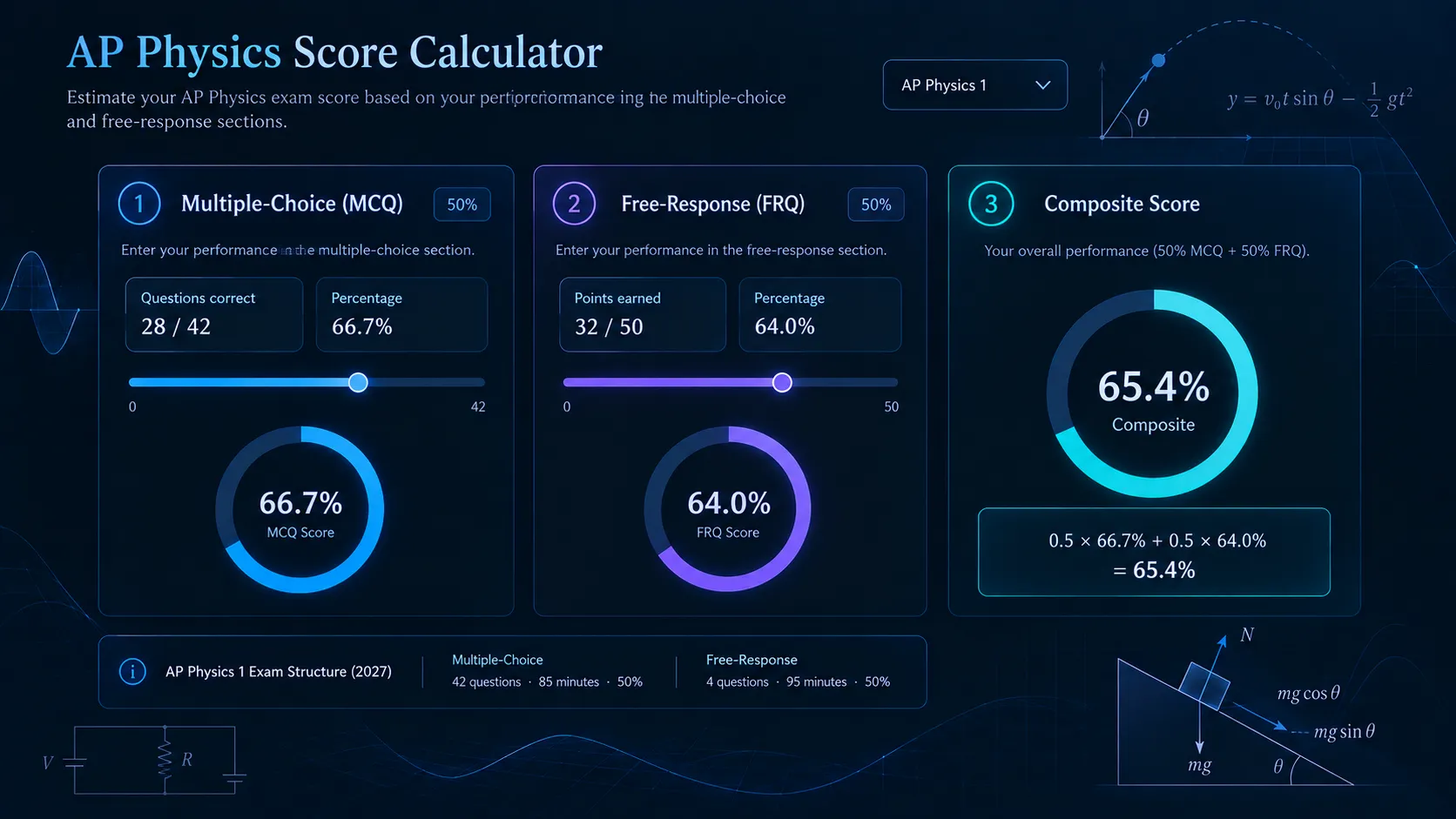
Choose your course above, enter how many multiple-choice questions you got right and roughly how well you did on the free response, and the calculator returns your weighted composite. Move either slider to see how the composite responds. It is free, requires no account, and covers all four AP Physics exams:
If you are not sure which calculator you need, or you are taking both Physics C exams, this page is the right place to start.
The exam format changed for 2027
All four AP Physics exams were updated effective with the May 2027 administration, and most score calculators online are still running the older numbers.
The current published format for every one of the four courses is identical:
| Section | Questions | Time | Weight |
|---|---|---|---|
| I: Multiple Choice | 42 | 85 minutes | 50% |
| II: Free Response | 4 | 95 minutes | 50% |
Before this change, the exams used 40 multiple-choice questions in 80 minutes and allowed 100 minutes for the four free-response questions. If you are working from a practice test or a calculator built for the 2025 or 2026 exam, the question count and timing will be slightly different from what you will sit.
The four free-response questions are one each of mathematical routines, translation between representations, experimental design and analysis, and qualitative/quantitative translation. All four exams are hybrid digital: multiple choice is completed in the Bluebook app, and free-response answers are handwritten in a paper booklet. Calculators are permitted throughout and a reference sheet is provided.
Confirm the details for your own exam year on the official pages, because College Board does revise them: AP Physics 1, AP Physics 2, AP Physics C: Mechanics and AP Physics C: Electricity and Magnetism.
Why this calculator does not hand you a 1 to 5
Almost every AP score calculator online will confidently tell you that a given composite is a 5. Compare two of them and you will usually find they disagree, because those cutoffs are guesses.
College Board does not publish a permanent raw-score-to-AP-score conversion table. Scoring is equated for each administration, so the composite required for a 5 shifts from year to year depending on the difficulty of that particular exam. A number presented as “the cutoff” is someone’s estimate from an older released exam, presented as fact.
So this calculator gives you the thing that is actually well defined: your weighted composite, calculated exactly the way the exam weights the two sections. Estimated 1 to 5 bands are switched off unless a site administrator has entered reviewed threshold assumptions and labelled where they came from. When they are shown, they are shown as estimates with the source stated.
A composite is more useful for revision anyway. It tells you where your points are actually being lost, and moving the two sliders shows you which section is worth your next study hour.
How the composite is worked out
Both sections carry equal weight, so:
Composite = (MCQ correct ÷ total MCQ) × 50 + (FRQ performance % × 50)
The multiple-choice input is straightforward: count how many you got right out of 42. There is no penalty for a wrong answer, so an unanswered question and a wrong answer cost you the same. Never leave one blank.
The free-response input is an estimate, and it is the part people get wrong in both directions. You are entering the percentage of available FRQ points you think you earned, not a feeling about how it went. If you are scoring a released practice exam, use the official scoring guidelines and count the points properly. Rubric points in AP Physics go to specific things: a correct free-body diagram, a labelled graph, a stated relationship, a justification that references a physics principle. Students routinely lose points for writing the right answer without the required reasoning, and routinely assume they earned points for work they never wrote down.
If you are unsure, run it twice, once pessimistically and once optimistically. The gap between the two composites tells you how much your uncertainty is actually worth.
What the numbers look like in practice
AP Physics 1 has historically been one of the harder AP exams, though the picture changed with the revised format. In the most recent published distribution, 19.8% of students scored a 5, 24.7% scored a 4, and 67.3% scored 3 or higher, from 174,401 test takers with a mean score of 3.12. That is a substantial shift from the years before the revision, when 3-or-higher rates sat in the mid-forties (College Board score distributions).
Two things follow from that. First, advice written before the exam was revised is out of date, including a lot of what you will find repeated about how nearly impossible a 5 is. Second, the composite needed for a top score in physics is lower than students expect from other subjects. You can miss a meaningful number of points and still score well. Panic about a handful of missed multiple-choice questions is usually misplaced.
After you calculate
A composite on its own does not raise a score. What raises a score is finding out which specific ideas are costing you points and fixing them.
Once you have your number, take the questions you got wrong and put them into the Physics AI solver to see the full worked method, or into the Physics AI Tutor if you would rather be walked toward the answer than shown it. For untimed practice with hints, use physics practice problems, and for AP Physics 1 specifically there is a dedicated AP Physics 1 practice area.
The calculator is free and unlimited. It does not use any credits.
Common questions
Which calculator should I use? The one matching your course. Use the course selector above, or go straight to Physics 1, Physics 2, C: Mechanics or C: E&M.
I am taking both AP Physics C exams. Do I get one score? No. Mechanics and Electricity & Magnetism are separate exams with separate scores, taken in separate sessions. Calculate each one on its own.
Why will it not tell me if I got a 5? Because nobody outside College Board can tell you that reliably before scores are released. The conversion is set for each administration. Any site giving you a definitive cutoff is estimating and usually not saying so.
What composite do I need for a 3? It varies by year, which is the entire problem with the question. Historically the thresholds for AP Physics are low relative to other subjects. Treat any specific number you see online as an estimate from an old exam.
Is this calculator accurate? The composite arithmetic is exact and matches the official 50/50 section weighting. The accuracy of your result depends entirely on how honestly you estimated your free-response performance.
Does guessing hurt my score? No. There is no penalty for a wrong answer on the multiple-choice section. Answer every question.
Is the calculator free? Yes, entirely, with no account required and no credits used.
Can I use it for a practice exam? Yes, and that is its best use. Score a released practice exam against the official scoring guidelines and enter the results.
When are AP scores released? Scores are typically released in July through your College Board account. Check the official score release information for your year.
Is Physicstan affiliated with College Board? No. AP and Advanced Placement are registered trademarks of the College Board, which does not endorse and was not involved in producing this tool.