
Physics Practice Problems
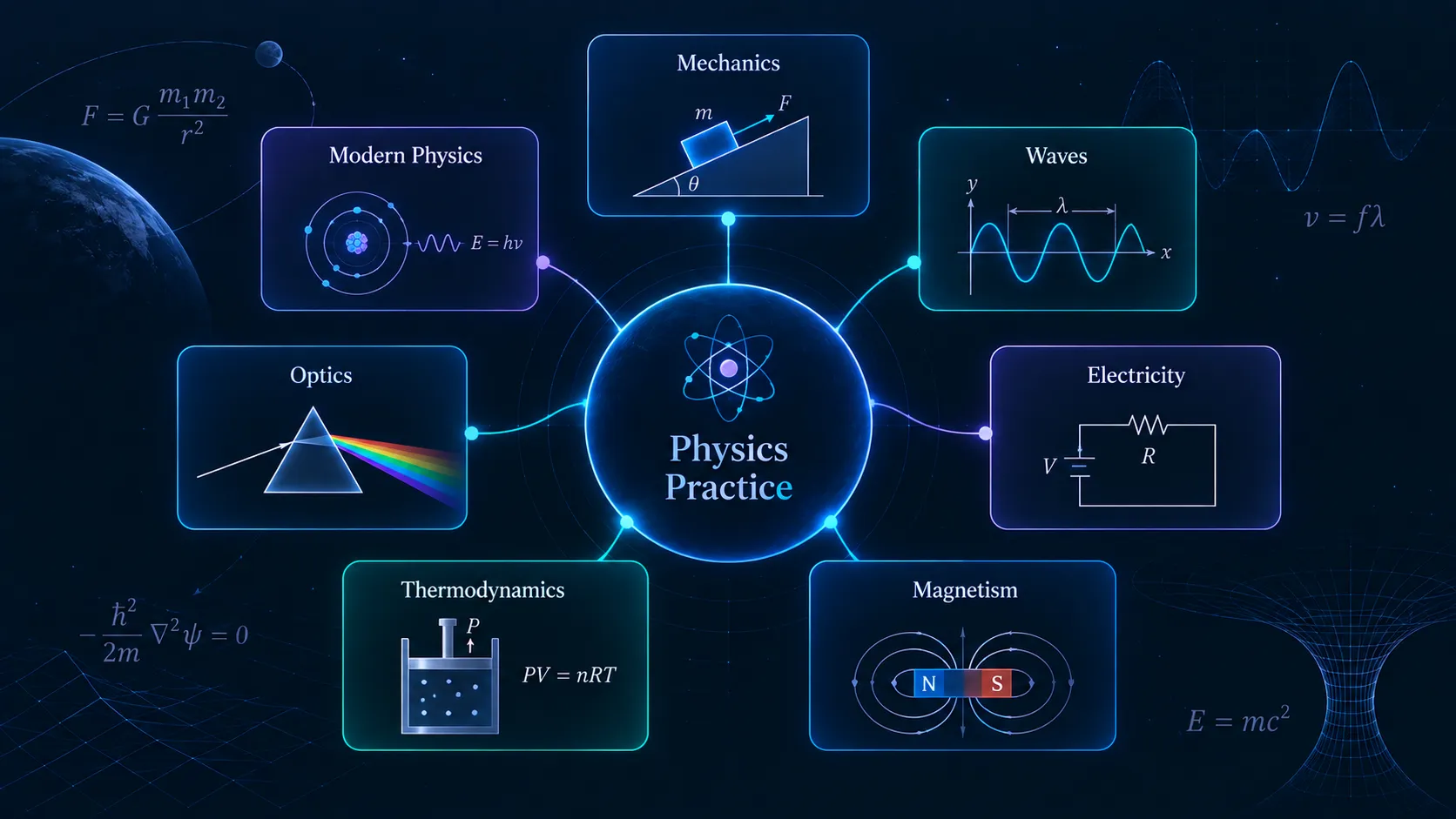
Pick a problem, attempt it properly on paper, take a hint only if you are stuck, then reveal the solution and compare. If your answer is wrong, paste your working into Check My Work and find out where it actually broke.
Every problem below is original and written for this page, with a hint that points at the setup rather than giving the answer away.
Use these the right way
Reading solutions feels productive and teaches you almost nothing. This is the single most common mistake physics students make, and it is why people can follow every worked example in a textbook and still freeze in an exam.
The order matters:
- Attempt it first, badly if necessary. Write down what is given, what you want, and a diagram. Even a failed attempt builds the retrieval pathway that reading does not.
- Take the hint only when genuinely stuck, and only after you have written something down.
- Reveal the solution and compare methods, not just answers. Getting the right number by the wrong route is worth knowing about.
- Redo it from a blank page a day later. If you cannot, you have not learned it yet.
That last step is the one nearly everyone skips and the one that actually moves marks.
Kinematics
Problem 1. A cyclist accelerates uniformly from 4.0 m/s to 12.0 m/s over a distance of 20 m. Find the acceleration.
Hint
You have initial speed, final speed and distance, but no time. There is exactly one constant-acceleration equation that omits time.
Solution
Using v² = u² + 2as:
144 = 16 + 2a(20)
128 = 40a
a = 3.2 m/s²
Sanity check: the cyclist speeds up, so a positive acceleration is expected, and the magnitude is plausible for a bicycle.
Forces and Newton’s laws
Problem 2. A 5.0 kg block slides down a frictionless incline angled at 25° to the horizontal. Find its acceleration.
Hint
Resolve the weight into components parallel and perpendicular to the slope surface, not into horizontal and vertical. The mass will cancel.
Solution
The component of weight along the slope is mg sin θ. The normal force cancels the perpendicular component and there is no friction.
ma = mg sin θ, so a = g sin θ
a = 9.8 × sin 25° = 9.8 × 0.4226
a = 4.1 m/s²
Notice the mass cancelled entirely. A 50 kg block would accelerate identically, which is worth remembering.
Energy
Problem 3. A 0.20 kg ball is dropped from a height of 1.8 m and rebounds to 1.2 m. How much energy was lost in the bounce?
Hint
You do not need any speeds. Compare gravitational potential energy before and after, using the change in height.
Solution
Energy lost = mg(h₁ − h₂)
= 0.20 × 9.8 × (1.8 − 1.2)
= 0.20 × 9.8 × 0.6
≈ 1.2 J
The energy has gone into sound, heat and deformation of the ball and floor. It has not disappeared.
Momentum
Problem 4. A 1200 kg car travelling at 15 m/s collides with a stationary 800 kg car. They lock together. Find their common velocity immediately after impact.
Hint
Momentum is conserved in the collision. Kinetic energy is not, so do not try to use energy conservation here.
Solution
Total momentum before = (1200 × 15) + (800 × 0) = 18 000 kg m/s
After the collision the combined mass is 2000 kg:
v = 18 000 / 2000
v = 9.0 m/s, in the original direction of travel
This is a perfectly inelastic collision. Check the kinetic energy before and after and you will find a substantial loss, which is expected.
Circular motion
Problem 5. A 900 kg car rounds a flat, unbanked bend of radius 40 m at 12 m/s. What friction force is required to keep it on the curve?
Hint
Friction is providing the centripetal force. Nothing else is acting horizontally.
Solution
F = mv² / r
= (900 × 12²) / 40
= (900 × 144) / 40 = 129 600 / 40
F ≈ 3.2 × 10³ N
Note that doubling the speed would quadruple the required friction, which is why bends are so unforgiving of small speed increases.
Circuits
Problem 6. A 6.0 Ω resistor and a 3.0 Ω resistor are connected in parallel across a 12 V supply of negligible internal resistance. Find the total current drawn from the supply.
Hint
Find the combined resistance first. In parallel it must come out smaller than the smaller of the two resistors, which is a useful check.
Solution
1/R = 1/6.0 + 1/3.0 = 1/6.0 + 2/6.0 = 3/6.0
R = 2.0 Ω, which is indeed less than 3.0 Ω
I = V/R = 12 / 2.0
I = 6.0 A
You can verify by branch: 12/6.0 = 2.0 A and 12/3.0 = 4.0 A, summing to 6.0 A.
Waves
Problem 7. A sound wave of frequency 512 Hz travels through air at 340 m/s. Find its wavelength.
Hint
One equation relates speed, frequency and wavelength. Check your units come out in metres.
Solution
v = fλ, so λ = v/f
λ = 340 / 512
λ ≈ 0.66 m
A useful habit: the wave speed is set by the medium, not by the source. Change the frequency and the wavelength changes to compensate.
Thermal physics
Problem 8. How much energy is required to heat 0.50 kg of water from 20°C to 80°C? Take the specific heat capacity of water as 4180 J/kg·K.
Hint
A temperature difference in kelvin is numerically the same as in degrees Celsius, so no conversion is needed for Δθ.
Solution
Q = mcΔθ
= 0.50 × 4180 × (80 − 20)
= 0.50 × 4180 × 60
Q ≈ 1.3 × 10⁵ J
Water’s specific heat capacity is unusually high, which is why it takes a surprisingly long time to boil a kettle.
Stuck on one of these?
Paste any problem above into the Physics AI solver for the full method, or open it in Tutor mode to be given one hint at a time instead of the answer.
If you attempted a problem and got a different number, that is the more useful case. Paste your working into Check My Work and it will find the earliest step that actually breaks rather than replacing your method with its own. Wrong-answer diagnosis teaches more than any correct solution.
Where students lose marks on problems like these
Patterns worth watching for, drawn from the mistakes that recur most:
- Not drawing a diagram. Research on physics students consistently finds that most do not draw a free body diagram, and that those who do score better. It is the cheapest mark you will ever buy.
- Resolving into the wrong axes. On an incline, resolve parallel and perpendicular to the slope, not horizontally and vertically.
- Using energy conservation on an inelastic collision. Momentum is conserved; kinetic energy is not.
- Losing the sign. Deceleration, downward displacement and current direction all bite here.
- Mixing degrees and radians. Especially in circular motion and oscillations.
- Forgetting the mass cancels. Then wondering why the answer depends on something it should not.
- Skipping the sanity check. If a car is accelerating at 400 m/s², something has gone wrong earlier.
Where to go next
- Preparing for an AP exam: AP Physics 1 practice has problems matched to that course, including fluids
- Estimating a score from a practice exam: AP Physics score calculator
- Working through an assignment rather than loose problems: physics homework help
- Learning a concept from scratch rather than practising it: use Learn mode on the solver
Common questions
Are these problems original? Yes. They were written for this page rather than reproduced from a textbook.
How many problems should I do? Fewer, properly, beats more, superficially. Six problems attempted from scratch and redone a day later will do more for you than thirty read through.
Should I look at the hint straight away? No. Write something down first, even if it is only the givens and a diagram. The hint is worth much more once you have identified where you are stuck.
Do these use credits? No. This page is free and requires no account. Credits are only used when you ask the AI something.
What level are these? Introductory, spanning late high school and first-year university. They are the standard problem types that everything harder is built from.