
AP Physics C: Electricity & Magnetism Score Calculator
AP Physics C: Electricity & Magnetism Score Calculator
Estimate your weighted AP Physics composite and explore how changes in MCQ or FRQ performance affect the result.
Enter your practice performance
Use raw MCQ correct answers and your estimated FRQ percentage.
Your estimate
Weighted from the configured AP Physics exam structure.
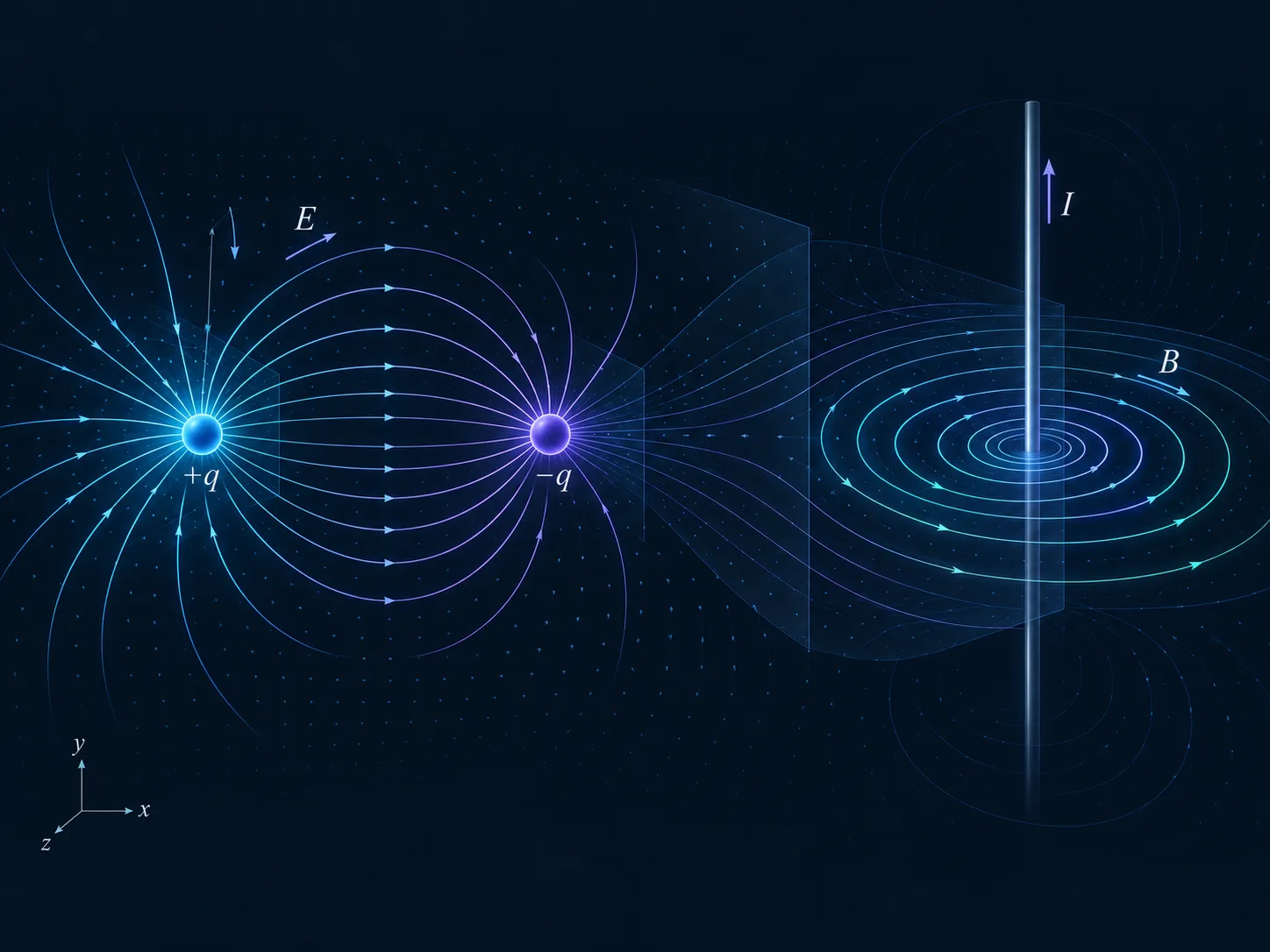
Enter how many of the 42 multiple-choice questions you got right and roughly what percentage of the free-response points you earned. The calculator returns your weighted composite using the official 50/50 split, with both sliders updating live.
Free, no account, no credits used. This calculator covers AP Physics C: Electricity and Magnetism, also written as E&M, E and M, or EM.
The AP Physics C: E&M exam format
Effective with the May 2027 exam, AP Physics C: Electricity and Magnetism uses:
| Section | Questions | Time | Weight |
|---|---|---|---|
| I: Multiple Choice | 42 | 85 minutes | 50% |
| II: Free Response | 4 | 95 minutes | 50% |
The 2027 exam is scheduled for Wednesday 5 May 2027, session 2.
The format has moved twice recently, so old materials are unusually unreliable for this exam. It used to be 35 multiple-choice questions in 45 minutes plus 3 free-response questions in 45 minutes. It then became a three-hour exam with 40 multiple-choice questions in 80 minutes and 4 free-response questions in 100 minutes. From May 2027 it is 42 questions in 85 minutes and 4 free-response questions in 95 minutes. A score calculator built on the 35-question structure will give you a meaningless number.
The four free-response questions are one each of mathematical routines, translation between representations, experimental design and analysis, and qualitative/quantitative translation. The exam is hybrid digital: multiple choice in Bluebook, free-response answers handwritten in a paper booklet. Calculators are permitted on both sections and a reference sheet is provided. Confirm details for your year on the official AP Physics C: Electricity and Magnetism exam page.
The two Physics C exams are now on separate days. In 2027, Mechanics is on 3 May and E&M is on 5 May, rather than the back-to-back afternoon arrangement students may remember from earlier years.
How the composite works
Composite = (MCQ correct ÷ 42) × 50 + (FRQ percentage × 50)
Multiple choice. Count your correct answers out of 42. No penalty for a wrong answer, so leave nothing blank.
Free response. Enter the percentage of available rubric points you earned, scored against the official guidelines rather than by checking whether your final answer matched.
E&M free response is where the gap between knowing the physics and scoring the points is widest of any AP Physics exam. Points are awarded for setting up the correct Gaussian surface or Amperian loop and saying why it was chosen, for stating the symmetry argument, for writing the integral with correct limits before evaluating it, and for defining the direction convention. A student who writes down the correct field expression from memory, without the derivation, can lose most of the available points on a question they fully understand.
The experimental design question is the other common gap. It asks you to design a procedure and analyse data, often by linearising a relationship and identifying what a graph’s slope represents. That is a distinct skill from solving field problems, and it is frequently the least practised.
If your FRQ estimate is uncertain, calculate twice with a pessimistic and an optimistic figure and see how much the difference is actually worth in composite terms.
Why there is no 1 to 5 estimate by default
Other E&M calculators will convert your composite into a predicted score. Check two of them and they usually disagree.
College Board equates scoring for each administration, so the composite required for each AP score moves with the difficulty of that year’s exam. There is no permanent conversion table to apply. Any specific cutoff you find is someone’s estimate from an older released exam, generally presented as fact.
This calculator returns the composite, which is exactly defined, and leaves the 1 to 5 conversion switched off unless a reviewed threshold has been entered with its source stated. Where an estimate is shown, it is labelled as an estimate.
What E&M scores look like
E&M has the strongest distribution of the four AP Physics exams.
In the 2026 distribution: 24% scored a 5, 24% scored a 4, 27% scored a 3, 17% scored a 2 and 8% scored a 1, giving 75% at 3 or higher (College Board 2026 score distributions). Nearly half of all test takers earn a 4 or 5.
This is selection rather than an easy exam. E&M is typically taken by students who have already sat Mechanics, are comfortable with calculus including integration in more than one dimension, and are heading toward engineering or physical science. The cohort is small and strong.
The useful consequence is that you should not read your class rank as a prediction. Being middling in an E&M class usually means you are well above the wider AP population. It also means the absolute composite needed for a good score is lower than it feels when everyone around you seems to be finding it manageable.
After you calculate
Take whatever you missed and work it properly rather than reading a solution.
The Physics AI solver will give the full derivation, and the Physics AI Tutor will give you the first move and let you finish. Ask for the calculus-based treatment explicitly. The recurring failure points in E&M are choosing the wrong symmetry for a Gauss’s law problem, mishandling the direction of induced current, and losing track of sign conventions in circuits with multiple loops. All three are setup problems rather than mathematical ones, which is exactly the part a finished worked solution teaches you least about.
For untimed practice, use physics practice problems. Other courses: the AP Physics score calculator hub, AP Physics 1, AP Physics 2 and C: Mechanics.
Common questions
Is E&M scored together with Mechanics? No. Two separate exams, two separate scores, and from 2027 two different days.
Should I take E&M if I have not taken Mechanics? It is possible but unusual. Most schools teach Mechanics first, and E&M assumes comfort with the mathematical apparatus you build there.
How much calculus do I need? More than Mechanics. Line, surface and volume integrals appear in Gauss’s law and Ampère’s law problems, along with differential relationships in circuits and induction.
How many questions can I miss and still get a 5? Not knowable in advance, because the conversion is set per administration. The AP Physics curve is historically generous compared to other subjects.
Does guessing hurt? No. There is no penalty for wrong answers. Answer all 42.
Are older released FRQs still worth practising? Yes. The content and the 50/50 weighting have not changed, only question counts and timing. Older free-response questions remain some of the best practice available.
Is the calculator free? Yes, unlimited, no account and no credits used.
Is Physicstan affiliated with the College Board? No. AP and Advanced Placement are registered trademarks of the College Board, which does not endorse and was not involved in producing this tool.