Physics AI Tutor
Physics AI Solver
Solve Physics Problems, Learn Concepts, and Get Concise step-by-step Help from your Physics AI Tutor.
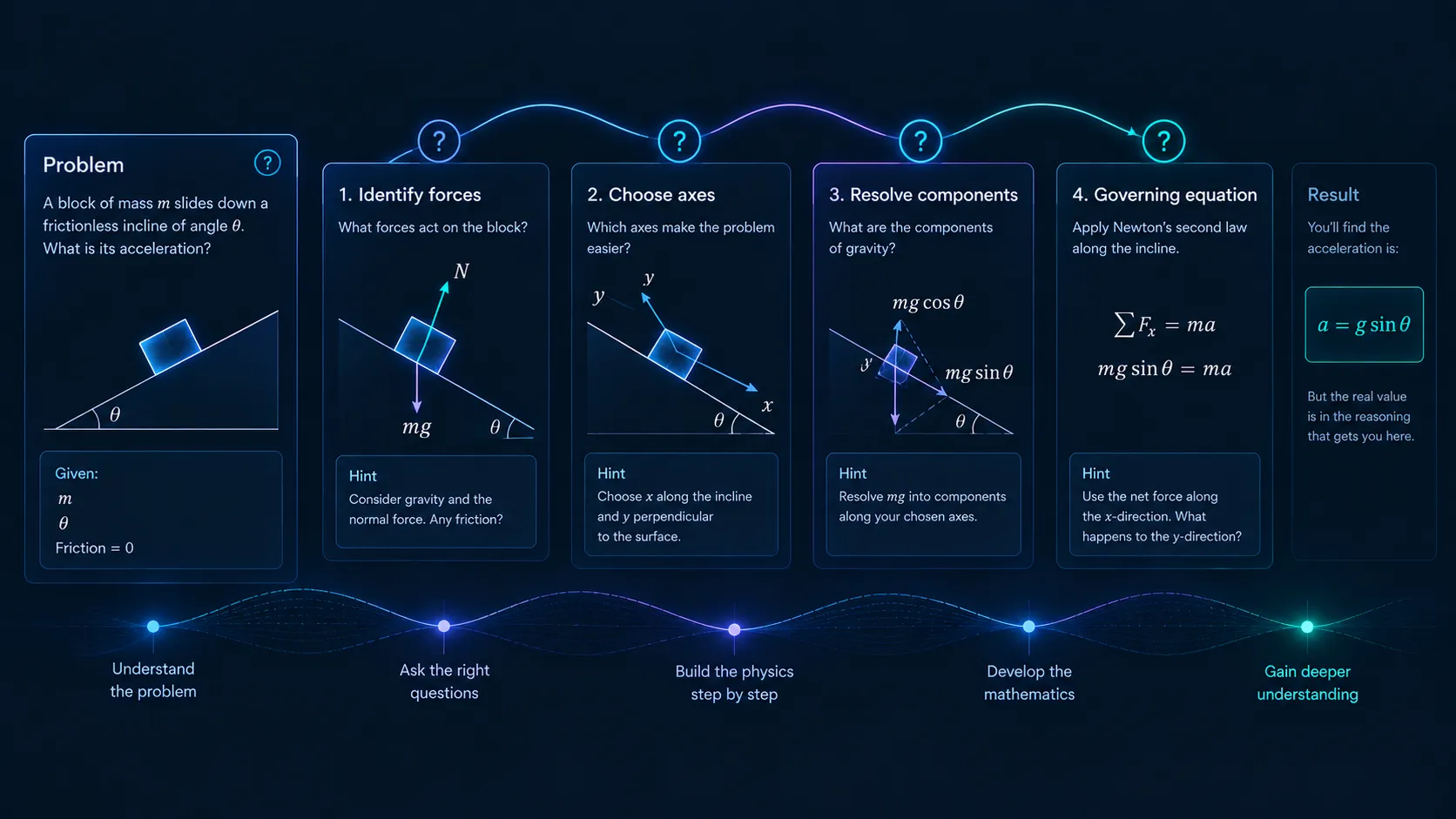
Paste a problem into the box above and Physicstan will not immediately solve it. Tutor mode opens with one useful hint or one guiding question, aimed at whatever step you are actually stuck on. You respond, it responds, and you keep going until the thing clicks. When you decide you want the full worked solution, ask for it and you get it.
That is the whole design. A tutor that helps you get there yourself, without turning into a guessing game you cannot escape.
Why a tutor mode instead of just a solver
A solver hands you a finished answer. That is genuinely useful when you are checking your work or short on time, and it is what the main Physics AI solver is for. It is also the fastest way to finish a problem set without learning anything, which most students discover the hard way around exam week.
There is now reasonable evidence that guided AI tutoring works differently. A Harvard study of 194 students in an introductory physics course compared a custom-built AI tutor against the department’s existing active-learning classroom, which was already carefully designed and well taught. Each student experienced both formats a week apart. Learning gains in the AI-tutored sessions came out roughly double those from the in-class sessions, and students reported feeling more engaged (Kestin, Miller et al., reported by the Harvard Gazette).
The detail that matters most in that study is easy to miss: the tutor was not a general chatbot. The researchers wrote structured instructions for how it should teach each lesson, scaffolded its behaviour, and pre-vetted the way it gave feedback. Pointing students at a raw chatbot is not the same intervention and should not be expected to produce the same result.
Tutor mode on Physicstan follows the same logic. The teaching behaviour is built into the mode rather than being something you have to prompt your way into every session.
One hint, not an interrogation
Most Socratic AI tutors have the same failure: they refuse to answer. You ask a question, get a question back, answer it, get another question back, and eventually close the tab. It is a well-documented complaint about the Socratic tools aimed at students, and it is why plenty of people abandon them and go straight back to a solver.
Physicstan takes a middle position on purpose. Tutor mode leads with a single hint or guiding question, the one most likely to unblock you. It does not ration information for the sake of pedagogy. If you say you want the whole solution, you get the whole solution, with the setup, assumptions, equation and working laid out in full.
In practice a session tends to run like this:
- You paste the problem and say where you are stuck, or just say you do not know how to start.
- You get one hint. Often it is about the setup rather than the algebra, because the setup is where most physics problems go wrong.
- You try the next step and paste what you got.
- It tells you whether that step holds up and nudges the next one.
- At any point you can ask for the full derivation, a different method, or an explanation of why a formula applies here.
Follow-ups stay in the same conversation, so you never have to re-describe the problem. You can switch to Solve or Learn mid-conversation and keep everything you have already established.
What it is good at
Getting unstuck on the setup. Choosing the reference frame, deciding which forces belong on the free-body diagram, working out whether momentum or energy is the right conservation law. This is the part a finished solution teaches you least about, because a written answer makes the choice look obvious in hindsight.
Working through your own attempt. Paste what you have done and it will find the earliest step that does not hold, rather than discarding your method and imposing its own. A valid but unusual approach stays yours.
Explaining a concept you half-understand. Ask why static friction can vary while kinetic friction does not, or what actually happens to the current when you add a parallel branch, and you get a compact explanation with the relevant equations and one worked example rather than a lecture.
Diagrams and photos. Upload a photo of the problem, your notebook page or a hand-drawn free-body diagram (JPG, PNG, WebP or PDF) and ask what is wrong with it.
Interactive explanation and reusable notes. Supported topics can include validated visual controls and Play/Pause animation. When the explanation is complete, Copy notes copies the full answer and Print / Save PDF creates a clean study copy for later revision.
Availability. It is there at 1am the night before a problem set is due, which is not something office hours can offer.
What it is not
It is not a replacement for your instructor, and it is not an authority. Language models are confident even when they are wrong, and physics is unforgiving about small setup errors that propagate. Physicstan re-checks arithmetic and unit dimensions independently of the model where it can, and shows you which of those checks actually passed. That covers calculation slips. It does not certify that the physical reasoning was right. What gets checked automatically and what you still need to verify yourself is spelled out on the accuracy and method page.
It is also not a way around your institution’s rules. Being walked toward an answer you then produce yourself is normal studying at most schools, but the policy that governs you is your school’s, not ours. Do not open it during a graded assessment unless you have been told outright that outside tools are allowed.
Tutor, solver, homework help: which one
All three run on the same engine and the same account. The difference is where you start.
- Use the Physics AI solver when you want a complete worked solution now, or a second opinion on an answer you already have.
- Use Tutor mode when you have time and want the method to stick.
- Use physics homework help when you have a whole assignment to work through and want to upload it and go question by question.
- Use physics practice problems when you want problems to attempt rather than problems to solve, with hints available before the solution.
Switching between them mid-conversation costs nothing extra and keeps your context.
Access and cost
Verify your email and you get 10 free credits. One substantive request costs one credit, in tutor mode the same as anywhere else. Requests that fail on our end are not charged, and rereading an old conversation is always free.
A tutoring session naturally uses more credits than a single solve, since each exchange is a request. That is worth knowing before you spend your free allowance on one long conversation. Plans and monthly credit allowances are on the pricing page.
Your conversations are private to your account, and you can delete any of them at any time.
Common questions
Will it just refuse to tell me the answer? No. It leads with a hint, and gives you the full solution as soon as you ask for it. The withholding is a starting position, not a rule.
Is this different from asking ChatGPT to tutor me? The teaching behaviour, the answer structure and the independent arithmetic checks are built in rather than prompted. You are not re-establishing how it should behave at the start of every session, and you are not relying on the model to grade its own arithmetic.
What level does it handle? High school through introductory university physics is where it is strongest. Upper-division and specialised material is less reliable and should be checked against your course materials.
Can it help me prepare for an exam? Yes, and this is probably its best use. Working old problems in tutor mode a week before a test will do more for you than reading finished solutions the night before.